
In today’s world, where climate change is a looming threat, assessing the environmental impact of everyday products is more crucial than ever. With increasing awareness about sustainability, consumers are becoming more interested in the carbon footprint of the products they use.
In this post, we’ll delve into the concept of product carbon footprint, understanding what it is and its implications, and how it is calculated. We’ll also offer sustainable solutions and actions consumers can take to reduce the carbon footprint associated with their product choices and habits.
Key Takeaways
- Understanding product carbon footprints is essential for making sustainable purchasing decisions.
- Calculating product carbon footprints involves assessing emissions throughout the product’s lifecycle.
- Carbon labels provide valuable information about a product’s environmental impact.
- Consumers can minimize their carbon footprint by choosing products with lower emissions and supporting sustainable practices.
What Does Product Carbon Footprint Mean, and What are its Implications?
Product carbon footprint refers to the total greenhouse gas emissions produced during the entire lifecycle of a product, from raw material extraction to manufacturing, distribution, use, and disposal.
The emissions caused by products and human activities have far-reaching implications for the planet. These effects can be seen in climate, environment, and global health changes. This concept might seem vast and complex, but understanding a product’s carbon footprint is essential because it allows consumers to quantify its environmental impact. By knowing the emissions associated with a product, consumers can make informed choices and support companies prioritizing sustainability. Additionally, assessing carbon footprints can help businesses identify areas for improvement and reduce the global warming potential contributions of their products and operations.
A sizable carbon footprint has significant consequences for both the environment and people, encompassing a broad spectrum of issues:
- Climate Change: The release of greenhouse gases like carbon dioxide warms the planet, leading to altered weather patterns, more extreme weather events, and rising sea levels. These changes impact everything from agriculture to wildlife, disrupting ecosystems and threatening biodiversity.
- Air Quality: Increased levels of pollutants not only harm the environment but also pose serious health risks to humans. From respiratory problems to heart diseases, the health implications are vast and concerning.
- Economy: Losses in agriculture productivity due to changing climates, damage to property from natural disasters, and increased healthcare costs due to pollution-related diseases have significant economic ramifications. Moreover, these costs are often borne by the most vulnerable populations, exacerbating issues of inequality.
- Cultural and Social Effects: From indigenous communities losing their homelands to droughts and famine forcing people to become climate refugees, the social implications are as critical as the environmental ones.
Calculating Product Carbon Footprint
Calculating individual product carbon footprint is essential to understanding and mitigating the impact of greenhouse gases on our climate. As outlined by Conservation International, a carbon footprint measures the total emissions of greenhouse gases in terms of carbon dioxide equivalents (CO2e) and includes gases such as carbon dioxide (CO2), methane (CH4), and nitrous oxide (N2O). These gases act like a blanket around Earth, trapping heat in our atmosphere and warming the planet.
Put simply, the warming effect of various gases is expressed in terms of the amount of CO2 that would have the same impact. For instance, if we talk about 5 tons of CO2 equivalent, we’re essentially saying that the emissions from a product, event, or activity are equal to the warming effect of releasing 5 tons of carbon dioxide into the atmosphere.
This standardization to CO2-equivalency allows for straightforward comparisons across various sectors and activities, considering that emissions vary for each product. It makes comprehending and communicating the environmental impact of different products and practices easier.
Another way of calculating a product’s carbon emissions involves conducting a life cycle assessment (LCA). While the concept of a carbon footprint zeroes in on the greenhouse gas emissions associated with activities, products, or services, a life-cycle assessment (LCA) takes a more expansive view–it examines the broader environmental impacts at each stage of the product’s lifecycle.
This process considers raw material extraction, manufacturing, transportation, use, and end-of-life disposal.
Life cycle assessments rely on data from various sources, including suppliers, manufacturers, and transportation companies. This data calculates emissions based on energy consumption, material usage, and waste generation. Advanced tools and software are often employed to streamline the calculation process and ensure accuracy.
According to Carbon Trust, determining the carbon footprint of any product involves setting specific boundaries or scopes for measurement. The two most common scopes are “cradle-to-gate” and “cradle-to-grave,” each covering different stages of the entire product lifecycle.
- The “cradle-to-gate” approach is primarily used in scenarios focusing on business-to-business (B2B) products. This method measures the total greenhouse gas emissions from the initial extraction of raw materials to the manufacture of the product, stopping at the factory gate before it is dispatched to another business. It’s a crucial metric for companies looking to assess and improve the sustainability aspects of their production processes.
- The “cradle-to-grave” measure expands the scope to encompass the entire lifecycle of predominantly business-to-consumer (B2C) products. That includes every phase, from the pre-processing stage, including raw material extraction to manufacturing and distribution to the use phase and, eventually, disposal.
The broader perspective afforded by LCA offers valuable insights into the overall environmental impact of products, empowering businesses and consumers to make choices that favor sustainability.
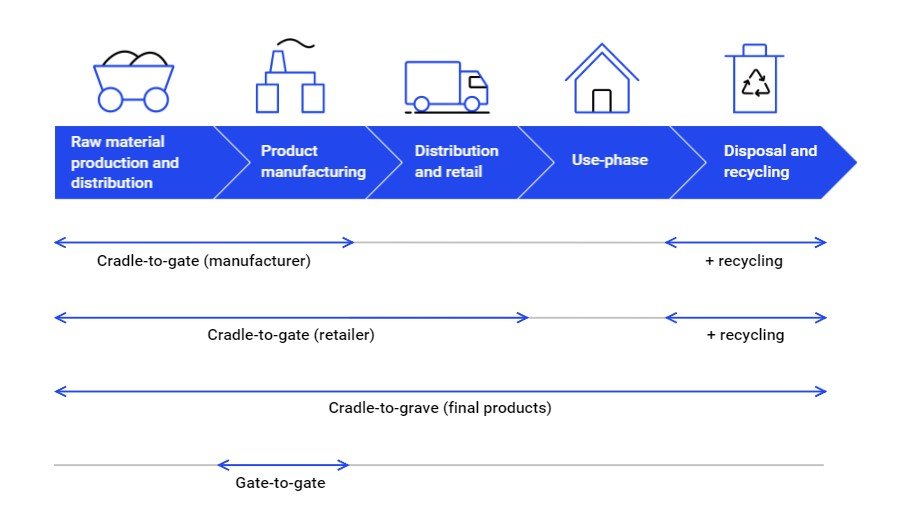
Image Source: https://www.carbontrust.com/what-we-do/product-carbon-footprint-labelling/product-carbon-footprint-label
Looking at the Carbon Footprint of Some Common Consumer Products
If you are intrigued by the environmental impact of everyday products, understanding their carbon footprint can shed light on your personal contributions to climate change and even inspire you to take climate action.
Data from sources like Clever Carbon, the University of Michigan’s Center for Sustainable Systems, and Our World in Data provide insights into specific products you use. Here’s a glimpse into some of their findings:
| Category | Product | Carbon Footprint (CO2-equivalents) | Details |
|---|---|---|---|
| Food | Meat | Up to 60 kg per kg of beef consumed | Due to methane emissions from cattle, feed production, and processing. |
| Fruits and Vegetables | About 1.1 kg per kg of produce | Can vary based on local growing practices and transportation distances. | |
| Dairy Products | Around 21 kg per kg of cheese produced | Largely due to cow’s methane emissions. | |
| Seafood | About 3-13 kg, depending on the variety | Large predatory fish and shrimp trawling can be more carbon-intensive. | |
| Beer | Around 900 g per liter of beer produced | Includes brewing process, packaging, and distribution. | |
| General | Smartphones | Approximately 80 kg per smartphone | Considers mining rare earth elements, manufacturing, and transportation. |
| Plastic Water Bottles | About 82 g per bottle | Includes production of plastic, bottling water, and distribution. | |
| Paper | Around 3.3 kg per kg of paper | From tree harvesting to production and recycling or disposal. | |
| Plastic Bags | About 10 g per bag | Cumulative impact is significant due to widespread use. | |
| Transportation | Automobiles | About 47 metric tons per car lifetime | Includes production, fuel consumption, and disposal. |
| Air Travel | Approximately 986 kg per passenger | Reflects the high energy cost of aviation fuel and airplane efficiency. | |
| Bicycles | Around 5 kg per kg of bicycle weight | Over the entire lifecycle, including production and disposal. | |
| Electric Vehicles (EVs) | 6-8 metric tons per vehicle lifetime | Depends on the manufacturing process and electricity source. | |
| Public Transit | About 0.1 kg per passenger-kilometer | Significantly lower than private cars. | |
| Home Appliances | Refrigerators | Approximately 400 kg over 12 years | Despite efficiency improvements, emissions are still notable. |
| Washing Machines | About 0.21 kg per wash cycle | Includes electricity use and production. | |
| Dishwashers | Approximately 200 kg over ten years | Efficiency varies with model and usage habits. | |
| Televisions | Around 80 kg over seven years | Depends on size, technology, and usage pattern. | |
| Microwave Ovens | About 25 kg per year | Considering average daily use. | |
| Electric Kettles | Around 0.015 kg per liter of water boiled | Can add up with frequent use. | |
| Air Conditioners | About 600 kg per year | Varies by efficiency, size, and usage patterns. | |
| Vacuum Cleaners | Approximately 16 kg per year | Based on once-a-week usage for an hour each session. |
How Carbon Labeling is Helping Shift Corporate and Consumer Behaviors
Not everyone has the leisure to delve into the intricacies of calculating a product’s carbon footprint. This reality puts into perspective the utility of carbon labels, especially for eco-conscious consumers.
What is Carbon Labeling?
In a recent review featured in the journal Nature Climate Change, carbon labeling is identified as an innovative system that sums up the complex data of greenhouse gases (GHGs) emitted during the production, distribution, and use of products and services into a simple indicator.
The label typically displays the product’s total emissions in CO2e, along with additional information about its environmental impact. A carbon label may also include details about the methodology used to calculate emissions and any certifications or standards the product meets.
This easy-to-understand label is then displayed for consumers at the point of purchase. The goal is to make it easier to understand the environmental impact of a product and make environmentally friendly choices. By understanding the “carbon footprints” of what they buy, consumers can steer towards options that emit less GHG emissions.

Image Source: https://observatorio2030.com.br/wp-content/uploads/2022/03/Revisiting-the-promise-of-carbon-labelling-2022.pdf
Carbon labeling systems are gaining ground globally. According to the Ecolabel Index, there are currently 455 ecolabels spread over 199 countries. These labels span 25 distinct sectors, 31 of which are dedicated to carbon footprint labels. Some notable ones are the American Grassfed Association (AGA), B Corporation, BASS (Product inventory for the construction industry), CarbonNeutral®, and Carbon Trust, among others. The Ecolabel Index database includes a complete list of these ecolabels and information about each organization and the products and sectors they cater to.
How It’s Helping in Changing Behaviors Toward Sustainability
The transparency provided by carbon labeling plays a crucial role in shifting behaviors toward more sustainable practices.
For Consumers
On the part of consumers, carbon labeling enables them to make choices that align with their values and environmental priorities. By providing clear and transparent information about the environmental impact of products, consumers can choose options with lower carbon footprints, thereby reducing their overall environmental impact.
For Companies
Carbon labeling also helps in driving corporate accountability and transparency. Companies that conduct product carbon footprint calculations and voluntarily disclose their product carbon footprints following global disclosure systems from organizations like CDP demonstrate a commitment to environmental stewardship and accountability. This transparency fosters trust among consumers and stakeholders, enhancing the company’s reputation and brand value.
Additionally, adopting carbon labeling has sparked innovation within industries as companies seek to reduce their carbon footprints and differentiate themselves in the marketplace. By adopting green business models, investing in cleaner technologies, optimizing production processes, sourcing materials responsibly, and integrating product life cycle accounting and reporting, companies can lower their emissions and offer more sustainable products to consumers. Such a culture of innovation benefits the environment and drives economic growth and competitiveness.
Carbon Labeling System Challenges
While carbon labeling holds significant promise in steering consumers towards more sustainable choices, it’s not without its hurdles. Broadening its adoption faces several notable challenges that need addressing.
- Gaps in understanding how these labeling systems work: Not all consumers are familiar with carbon footprints, making it hard to interpret what the labels mean or why they should care. This lack of awareness can dilute the potential impact of carbon labels on buying behavior.
- Accurate data collection: Detailed information on every phase of a product’s life—from manufacturing to disposal—is necessary to generate reliable carbon footprint labels. Gathering this data is not only time-consuming but can also be resource-intensive. Moreover, methodologies can vary, raising concerns about the consistency and comparability of reported PCF across different labels and products.
- Designing universally applicable labels: The global market hosts a dizzying array of products and industries, each with its unique environmental footprint. Creating a labeling system adaptable across such diversity while remaining simple and understandable for the average consumer is a formidable task. It will entail a comprehensive research and case study on consumer and corporate behavior, a universal product life cycle accounting and reporting standard, and a solid regulatory design framework.
- Ensuring the labels drive real change: There’s a need for broader educational efforts to boost consumer engagement and trust in these labels. Without this, even the most well-designed carbon labeling systems might fall short of their intended environmental impact.
Addressing these challenges requires collaboration among scientists, policymakers, industries, and consumer groups. Fostering a deeper understanding of carbon labeling and striving for improved accuracy and usability can help overcome these obstacles. It can also significantly enhance the effectiveness of carbon labels as tools for promoting environmental responsibility among consumers worldwide.
Beyond Product Carbon Labels: More Ways to Minimize Product Carbon Footprint
Although carbon labels play a crucial role in enlightening consumers about the environmental impact of their purchases, their potential to minimize product carbon footprints is inherently limited. It’s the actions of consumers, informed by these labels and motivated by a commitment to sustainability, that truly harness the power to make a difference.
As a consumer yourself, you can extend your impact far beyond buying green products by championing sustainable habits in every aspect of your life. Here are several ways to do just that:
- Support Sustainable Practices: If you need to buy new products, purchase from companies prioritizing sustainability and environmental stewardship. Supporting businesses that use renewable energy, reduce waste, and minimize emissions can help drive positive change.
- Reduce Energy Consumption: Minimize energy consumption in your daily life by using energy-efficient appliances, reducing water usage, and opting for renewable energy sources whenever possible.
- Reuse and Recycle: Embrace a circular economy and improve sustainability practices by reusing products, recycling materials, and minimizing waste. By extending the lifespan of products and reducing the need for new materials, you can reduce emissions and conserve resources.
- Choose Alternative Transportation: Opt for eco-friendly transportation options like walking, cycling, or public transit whenever possible. Reduce your carbon footprint by carpooling, combining errands, and avoiding unnecessary travel.
- Educate Others: Spread awareness about the importance of reducing carbon footprints and encourage others to make sustainable choices. By advocating for environmental stewardship in your community, you can amplify the impact of individual actions and inspire positive change.
Conclusion
Assessing the environmental impact of everyday products is essential for promoting sustainability and combating climate change. By understanding product carbon footprints, consumers can make informed choices that minimize their environmental impact and support companies that prioritize sustainability. Through initiatives such as carbon labeling and life cycle assessments, individuals and businesses can work together to create a more sustainable future for the next generations.
Remember that every item you buy has its own impact on the environment. So, make conscious choices when shopping. Opting for products with lower carbon footprints benefits the planet and encourages manufacturers to adopt more sustainable practices in their value chain. By being mindful of your purchases, you have the power to contribute to a healthier world.
Choose wisely and take pride in knowing that your decisions are part of a collective effort to make a positive difference for our planet.
Frequently Asked Questions
A product carbon footprint (PCF) is a measure of the total emissions, particularly greenhouse gases (GHGs) such as carbon dioxide equivalents (CO2e), associated with a product throughout its life cycle, including raw material extraction, production, use, and end-of-life disposal or recycling.
Emissions, including carbon emissions, greenhouse gases (GHGs), and other gases like methane and nitrous oxide, contribute to PCFs. These emissions are quantified in terms of carbon dioxide equivalents (CO2e).
Calculating the life cycle carbon footprints of products is crucial in understanding and reducing their environmental impact. It helps in identifying opportunities for sustainable practices, gas reduction, and meeting greenhouse gas emissions reduction targets, especially with the increasing focus on environmental sustainability and renewable energy.
You can quantify the carbon emissions of your products using life cycle assessment (LCA) methodologies, which take into account the total GHG emissions from cradle-to-gate or even through end-of-life, to provide a comprehensive view of your product’s environmental impact.
Carbon labeling provides consumers with transparent information about a product’s environmental impact, including its carbon footprint. By making informed choices, consumers can support sustainable products and drive demand for environmentally responsible practices throughout the supply chain.
You can reduce a product’s carbon footprint by implementing sustainable practices throughout a product’s life cycle, such as sourcing raw materials responsibly, minimizing energy consumption, optimizing supply chain efficiency, and incorporating recycling into the end-of-life phase.
Ensuring the transparency and verification of your product’s carbon footprint can be achieved through third-party certifications, compliance with international standards, and making use of tools like a carbon calculator to disclose and validate the environmental performance of your products.
Yes, there are specific standards and labels designed to evaluate product carbon footprints and provide consumers with transparent information about the environmental impact of products. One prominent example is the “Footprint of Your Products” label, which quantifies the carbon emissions associated with a product’s entire lifecycle, from raw material extraction to end-of-life disposal. This label adheres to internationally recognized standards and methodologies, ensuring consistency and credibility in carbon footprint assessments.
Reducing a product’s carbon footprint mitigates climate change, conserves natural resources, and minimizes environmental degradation. It also enhances corporate reputation, fosters innovation, and aligns with sustainable development goals.
Companies can verify the accuracy of their carbon footprint calculations through third-party verification processes. These processes ensure adherence to international standards and provide credibility and transparency in reporting emissions data.
Incorporating renewable energy sources, such as solar or wind power, into production processes can significantly reduce a product’s carbon footprint by lowering reliance on fossil fuels and minimizing greenhouse gas emissions.
Recycling materials reduces the need for virgin resources and energy-intensive production processes, thereby lowering a product’s carbon footprint. It also diverts waste from landfills, reducing emissions associated with waste disposal.
Businesses can measure and reduce the carbon footprint of their products through comprehensive life cycle assessments, product life cycle accounting, adoption of sustainable production practices, investment in renewable energy, and optimization of supply chain efficiency.