In the digital age, online shopping has become a staple, providing consumers with the convenience of purchasing goods and services without leaving the comfort of their homes. However, this convenience comes with environmental repercussions.
It may sound contradictory, but shopping online can be less eco-friendly than visiting a physical store. As highlighted by the World Economic Forum, the surge in e-commerce is fueling increased traffic congestion and higher emissions. Predictions suggest a 36% rise in delivery vehicles in city centers by the decade’s end, escalating emissions, pollution, and congestion.
Furthermore, by 2030, emissions from urban last-mile delivery—referring to the product’s journey to the consumer’s doorstep—are expected to soar by over 30% across 100 cities worldwide.

Image Source: https://www.weforum.org/agenda/2020/01/carbon-emissions-online-shopping-solutions/
Besides exacerbating traffic congestion and emissions, online shopping facilitates a throwaway culture. The ease and convenience of purchasing products online have led to increased consumerism, where goods are bought, used briefly, and then discarded at an alarming rate. This cycle is further fueled by fast fashion and electronic gadgets designed with planned obsolescence in mind, encouraging consumers to buy the latest versions of products continuously.
As a result, landfills swell with perfectly usable items, contributing to waste and environmental degradation. Moreover, the vast amount of packaging required for shipping these goods adds another layer to the problem, as most packaging materials, notably plastics, are single-use and not biodegradable.
One initiative that advocates for sustainable consumerism by tackling the carbon footprint associated with e-commerce is EcoCart. This revolutionary tool empowers online shoppers and e-commerce businesses to combat climate change without sacrificing their daily routines or profits. Let’s explore what makes EcoCart a game-changer in the fight against climate change.
Key Takeaways
- EcoCart enables shoppers to offset carbon emissions at no additional cost.
- It provides e-commerce platforms with an easy-to-implement solution that appeals to eco-conscious consumers.
- The initiative supports various projects focused on carbon offsetting, from reforestation to renewable energy.
- By using EcoCart, businesses can enhance their brand image and customer loyalty through demonstrated environmental responsibility.
- The platform offers transparency by showing the exact impact of the offset made with each purchase.
- While a valuable tool in the short term, EcoCart’s approach should complement, not replace, efforts towards overall sustainability and emission reductions in production and consumption.
What is EcoCart, and How Does It Work?
EcoCart is a browser extension or plugin designed to offset the carbon footprint generated by online shopping. It seamlessly integrates into popular e-commerce platforms, such as Amazon, Shopify, and others, allowing users to calculate the carbon footprint of their purchases. It considers factors such as manufacturing, packaging, and shipping. It then offsets a portion of the funds towards certified carbon offset projects, such as reforestation initiatives, renewable energy projects, or methane capture programs.
Here’s a look at how EcoCart works:
- Installation and Setup: Users can easily install EcoCart as a browser extension, automatically activating when shopping online. Alternatively, some platforms offer direct integration, simplifying the setup process.
- Carbon Emission Calculation: Once installed, EcoCart automatically calculates each purchase’s carbon footprint based on various parameters, such as product type, shipping method, and distance.
- Offsetting Mechanism: After calculating the emissions, EcoCart allocates a portion of the purchase amount towards verified carbon offset projects. These projects adhere to rigorous standards set by reputable organizations like the Gold Standard or Verified Carbon Standard.
The Science Behind Carbon Offsetting
Carbon offsetting is a crucial tool in the effort to combat climate change. It acts as a bridge while the world gradually shifts towards more sustainable energy and production practices.
At its core, carbon offsetting allows individuals and companies to invest in environmental projects worldwide to balance out their carbon footprints. This could involve funding renewable energy sources, such as wind or solar power projects, that replace coal-fired power plants or investing in reforestation projects that absorb CO2 from the atmosphere.
Not all carbon offset projects are created equal, however. Their integrity and impact depend heavily on rigorous validation and verification processes. This is where standards, such as Verra’s Verified Carbon Standard (VCS) and the Gold Standard, come into play. These standards ensure that projects produce real, measurable, and long-term benefits related to climate change mitigation. They also confirm that the reductions would not have happened without the funding generated from carbon credits, a concept known as ‘additionality.’
For example, EcoCart’s alignment with such standards means that when you purchase through an EcoCart-enabled platform, you support projects scientifically vetted to reduce greenhouse gas emissions.
For the Eco-Conscious Shoppers and E-Commerce Businesses
Today’s consumers are increasingly conscious of their environmental footprint, actively seeking sustainable options in their purchasing journey. This awareness has translated into demand, with more people preferring products that lessen their impact on the planet and are willing to invest more in them.
A telling 2021 GreenPrint Survey highlighted this shift, revealing that nearly two-thirds (64%) of Americans are prepared to pay a premium for sustainability. However, the survey also uncovered a significant gap — while most consumers (74%) want to make responsible choices, they often struggle to identify genuinely sustainable products. Further, the survey found that the environmental friendliness of a product distinctly influences the buying decisions of 73% of Americans, and a staggering 78% are more inclined to buy something explicitly labeled as eco-friendly.
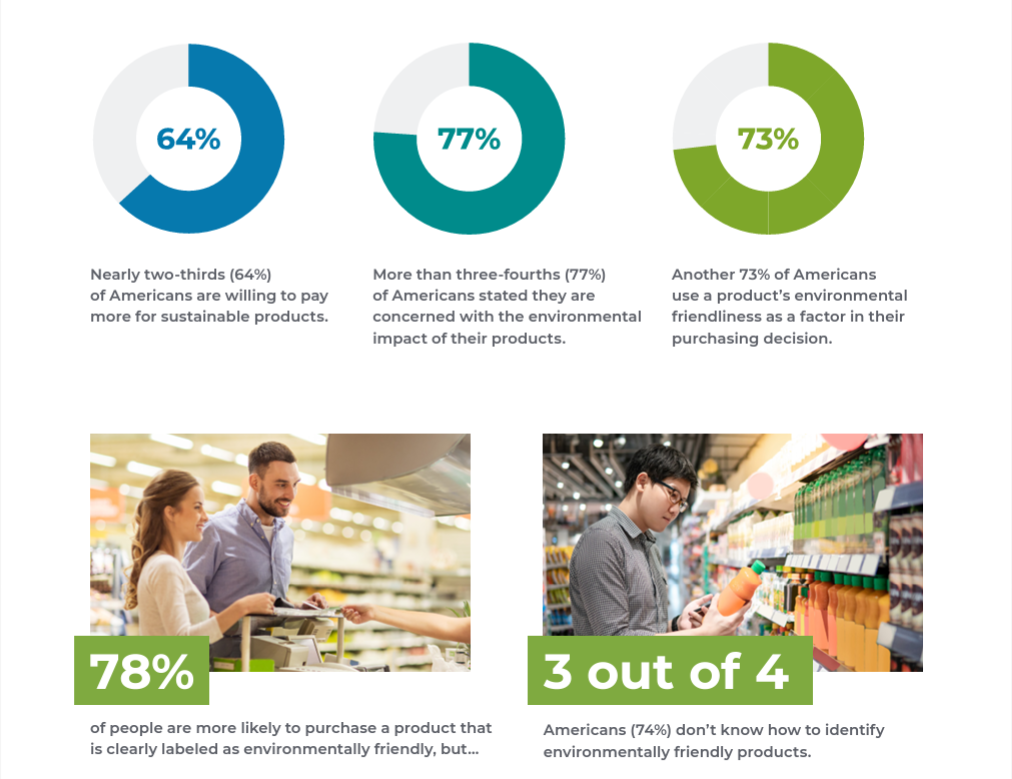
Image Source: https://greenprint.eco/wp-content/uploads/2021/03/GreenPrint-Business-of-Sustainability-Index_3.2021.pdf
This is where EcoCart comes into play—it bridges this crucial gap between consumer intent and action. EcoCart empowers consumers by making it easier for them to recognize and support environmentally friendly products and brands. Beyond that, the tool also helps in:
- Ensuring user convenience while driving their environmental impact through seamless integration and automatic operation.
- Enabling consumers to contribute to mitigating climate change and promoting environmental sustainability through carbon emissions offsetting.
For e-commerce platforms and online retailers, incorporating EcoCart is a strategic move towards sustainability. It adds value to eco-conscious customers, enhancing customer satisfaction and loyalty. Moreover, it aids these businesses in aligning with global sustainability goals and improving their corporate social responsibility profile. Implementing EcoCart also differentiates brands in a competitive market by highlighting their commitment to environmental conservation.
Implementing EcoCart has yielded tangible benefits for businesses, illustrating how incorporating sustainability can positively impact the bottom line. Various case studies underscore this point, revealing significant improvements in metrics critical to e-commerce success following EcoCart adoption.
Take, for instance, Tribe Kelley, a made-in-the-USA apparel brand that prides itself on ethical production and sustainable practices. After integrating EcoCart into its storefront, the brand witnessed an impressive 19% increase in cart conversion rates.
Similarly, Simbly, an eco-conscious furniture company known for its sustainably sourced and produced items, experienced a remarkable 38% increase in its average order size post-EcoCart integration. Comparing sales data from six months before and after adopting EcoCart, the brand observed an uplift in order values and a deeper engagement from customers eager to support a business contributing positively to the environment.
These instances highlight EcoCart’s role as a tool for carbon offsetting and a strategic asset for businesses aiming to thrive in a market increasingly driven by sustainable consumerism.
Where Contributions Go
One may wonder where the contributions directed by EcoCart go. The platform collaborates with various impactful and meaningful carbon offsetting projects worldwide. These projects span reforestation efforts in the Amazon rainforest, support for wind and solar farms in India and the United States, and even initiatives focused on providing clean cookstoves in Rwanda to reduce reliance on wood burning.
Each project is selected based on its ability to provide verifiable carbon reductions alongside socio-economic benefits for local communities, thus ensuring a multiplicity of positive impacts.
Transparency and trust are at the heart of EcoCart’s operations. As such, it ensures that consumers can see precisely how their decision to make purchases carbon neutral is making an impact.
Each EcoCart-supported project includes detailed information about the initiative’s specifics, including its location, purpose, and certification standards. This level of transparency builds trust between the consumer, the e-commerce retailer, and EcoCart itself, as everyone involved can clearly see the tangible outcomes of their efforts to combat climate change.
Challenges and Future Outlook
While EcoCart presents a promising solution, it faces challenges such as scalability, widespread adoption, and the need for continuous improvement in carbon calculation accuracy. Additionally, critics argue that carbon offsetting through platforms like EcoCart can lead to complacency, allowing individuals and businesses to “pay their way out” of being truly sustainable. Hence, while supporting platforms like EcoCart, consumers and businesses must strive to reduce overall emissions and adopt eco-friendly practices.
Despite such challenges, EcoCart’s future outlook appears optimistic, especially given the growing awareness of environmental issues and consumer demand for sustainable practices.
Conclusion
EcoCart offers a practical and accessible means for individuals and businesses to contribute to environmental sustainability. By harnessing the power of technology and collective action, EcoCart proves that every online purchase can make a positive difference in shaping a greener future. So, whether you’re a consumer looking to make your shopping more sustainable or an e-commerce business aiming to align with environmental values, EcoCart offers a pathway towards a greener future—one purchase at a time.
Frequently Asked Questions
Yes, EcoCart requires minimal effort from users as it automatically activates during online shopping.
EcoCart is typically free for users, although some platforms may offer premium features or optional donations.
Yes, EcoCart can be used globally, although the availability of certain features or integrations may vary by region.
While primarily designed for desktop browsers, efforts are underway to develop mobile-compatible versions of EcoCart.
EcoCart utilizes advanced algorithms to estimate carbon emissions based on various factors, but exact accuracy may vary depending on data availability and the complexity of individual purchases.