It’s long been established that the automotive and transportation industries are two of the biggest contributors to environmental degradation, and the statistics reflect that:
- Approximately 80 million vehicles are produced annually, demanding 112 million tons of materials. (World Economic Forum, 2024)
- CO2 emissions from transport accounts for nearly one-fifth of the world’s carbon dioxide emissions. (Our World in Data, 2020)
- Road travel represents three-quarters of total transport emissions, most of which are from passenger transport, contributing 45.1% (Our World in Data, 2020)
- Over 50 million vehicles each year reach the end of their service life globally. Many end-of-life vehicles (ELVs) are stockpiled at poorly managed scrap yards, presenting environmental and health risks due to the hazardous chemicals they contain. (Implementing Sustainable Low and Non-Chemical Development in Small Island Developing States (ISLANDS), 2023)
Fortunately, green changes are coming in waves within these industries–not only due to public pressure but also the legal norms being processed by organizations such as the European Union. So, industry players have only one thing left to do: adapt to the new situation as soon as possible and implement ecological solutions that will benefit Mother Nature and their businesses.
Here’s a look at some of the green changes happening in automotive and transportation and their challenges.
Cleaning Up the Supply Chain
As carbon emissions and scarcity of natural resources receive more attention, sustainable value chains have become critical, especially in the automotive industry.
More car manufacturers are implementing various initiatives to adopt and promote sustainability through their supply chains. While the initial focus was on reducing greenhouse gas emissions, many are gradually moving towards incorporating more sustainable development goals (SDGs) in their agenda. That includes emphasis on material waste management, efficient energy and water use, biodiversity, and climate change.
A couple of examples of how automakers are cleaning up their supply chains include:
- Increasing investment in sustainability research and development. That includes finding means to reduce vehicle weight and improve the longevity of EV batteries and the efficiency of conventional internal combustion engines to enhance overall performance, reduce emissions, and promote better fuel economy.
- Integration of renewable energy. With energy supplies getting smaller, automakers are increasingly relying on renewable energy sources to power their manufacturing operations. For instance, all Tesla factories are designed to run on renewable energy from solar, wind, and other carbon-free sources. Likewise, car giant Stellantis has partnered with Vulcan Energy to develop geothermal projects to decarbonize the energy mix of Stellantis’ industrial site in France.
- Embracing circularity. While EVs are considered eco-friendly due to their minimal to zero emissions, the same thing cannot be said about their lithium-ion batteries, which significantly impact their entire lifecycle. Many car manufacturers are taking a closed-loop approach to battery production to offset that. For instance, BMW Brilliance Automotive, the joint venture concept of BMW in China, procures the raw and rejected battery materials from EV test vehicles and systems and reuses them to create new battery cells. It also plans to include end-of-life vehicle batteries into the loop to further conserve resources and reduce carbon emissions from battery production.
- Carbon offsetting. Many automakers still have a long way to go to achieve net zero emissions in their manufacturing process. That’s why they invest in carbon offset credits to counterbalance the emissions they produce. These credits are used to fund emission reduction projects and ventures elsewhere.
Although the automotive industry’s drive to clean its supply chains is commendable, it’s facing challenges due to the lack of standardized frameworks, tools, and performance indicators. As a result, many automakers are overwhelmed and unsure how to start their sustainability journey.
To address this gap, there needs to be a comprehensive yet unified set of metrics that cover different SDGs. This can help simplify reporting and disclosures in the automotive industry, allowing automakers to accelerate their sustainability efforts. It will also enable investors to understand the overall performance of car makers, which can support their financing decisions.
Meeting Green Talent Demands
As greener practices and technologies become more widespread in the automotive and transportation industries, we’re seeing a massive demand for green skills across the board. These talents are crucial to ensuring an efficient and accelerated transition to greener economies.
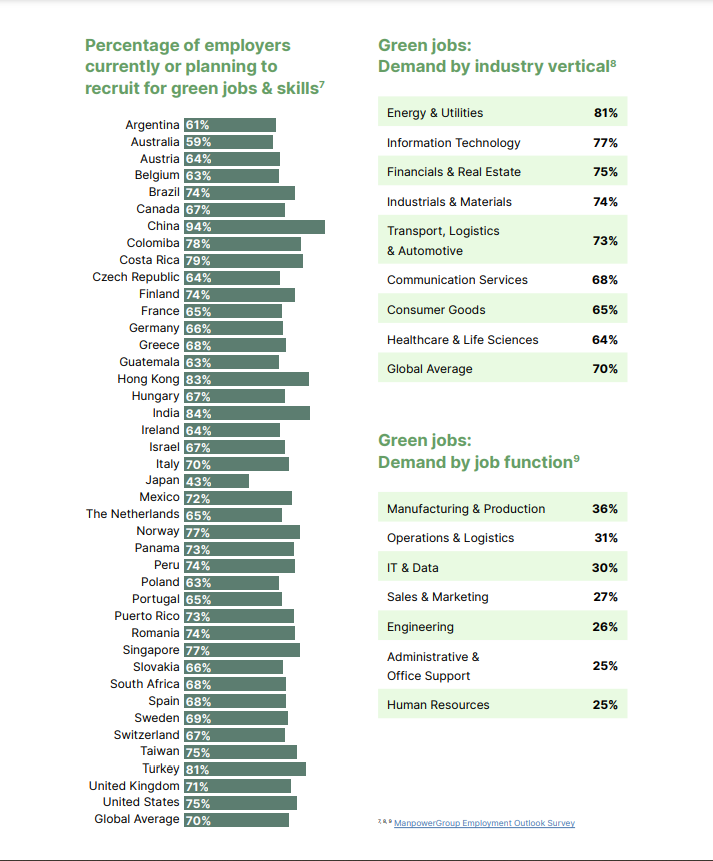
ManpowerGroup recently surveyed about 39,000 employers in 41 countries. Their findings reveal that 70% of employers are looking to hire people with sustainability skills. Among the industries where demand is high include energy and utilities, IT, financial and real estate, industrials and materials, and transport, logistics and automotive.
While this is great news, especially regarding job creation, there are a handful of challenges hampering green investments and developments.
- Green skills are in short supply. According to the same survey from ManpowerGroup, Within the automotive and transportation industries alone, it is estimated that there is a 76% global shortage of skilled professionals, including green talents.
- A lack of coherence between skills and environmental regulations creates a skills bottleneck, leading to serious skill shortages.
- Green progress is a critical consideration when workers are evaluating a job opportunity. The lack of clear and visible action on their end makes it a challenge for employers to attract the best green talent for their needs.
Reskilling programs and strategies must be prioritized to address the first two challenges. Equipping people with diverse green competencies can help build a robust green talent pipeline in the automotive and transportation industries. It can also help the current workforce adapt to changing environmental policies, infrastructure, and technologies. Likewise, coordination among employers and national planning and labor agencies can clarify skill requirements in the context of new environmental regulations.
As for the third challenge, employers can tackle the perception gap by considering workers’ opinions regarding green transition and incorporating them into their recruitment efforts. Working on their environmental credentials and being explicit about their green progress are also valuable actions for employers within the automotive and transportation industries to attract and retain the best sustainability professionals.
Changing Drivers’ Habits Through Eco-Driving Adoption
Excessive fuel use is one of the biggest sources of expenses for many transport companies, not to mention a significant driver of vehicle emissions. Aggressive driving, which includes frequent rapid acceleration and harsh braking and cornering, can increase fuel consumption by up to 40%. It can also reduce a vehicle’s performance and lifespan, resulting in higher fuel and maintenance costs and more emissions while on the road.
Eco-driving is identified as a suitable solution for the identified problems above. This special driving technique focuses on fuel economy and road safety, helping reduce transportation’s negative environmental impacts while ensuring driver and passenger safety and cost savings.
The concept of eco-driving has been around for a long time and is widely adopted by companies as part of their fleet management. So why don’t more drivers worldwide use it to reduce their carbon footprint?
It all comes down to established paths and habits that are difficult to eradicate. Instructors at driving schools often fail to teach students how to drive a car in a way that’s as eco-friendly as possible. As a result, many young drivers are unaware that this technique can make a big difference in their driving experience and vehicle performance and emissions. Eventually, they develop poor driving habits and stick to them consistently throughout their careers.
It takes a bit of self-awareness to change those habits and develop a new driving technique. To that end, drivers need to pay attention to the following points to learn to adopt eco-driving gradually:
- An efficient car and proper tire pressure
- Fast starting and dynamic acceleration
- Smooth shifting to higher gears
- Smooth driving, in which, on long trips, setting the cruise control to a specific value
- Engine braking whenever it comes into play
- Stopping with the engine off
- Staying alert while driving provides more time to react to unexpected events.
Drivers also need support to learn how to drive mindfully. Therefore, cargo companies or carriers must provide adequate training before putting drivers on the road. They should also complement their drivers’ training with ecological solutions that would drive their sustainability further.
The road transport services offered by AsstrA, for example, ensure efficient and safe road freight transportation for both drivers and the environment. The company trains drivers to prioritize eco-driving and integrates various measures to monitor and prevent harsh driving events. It also guarantees complete reliability by adhering to relevant rules, obtaining permits and route approvals, and maintaining financial safeguards.
More Electrics on the Road
Electric vehicles are, perhaps, the most telling of all the solutions that the automotive and transportation industries have come up with to combat climate change. Because they produce virtually zero emissions, they help improve air quality, which is better for people and the environment.
Also, as EVs are nearly silent on the road when traveling at low speeds, they don’t contribute to chronic noise pollution that has been linked to various health conditions, including hearing damage/loss, stress, sleep disturbances, and even cardiovascular diseases.
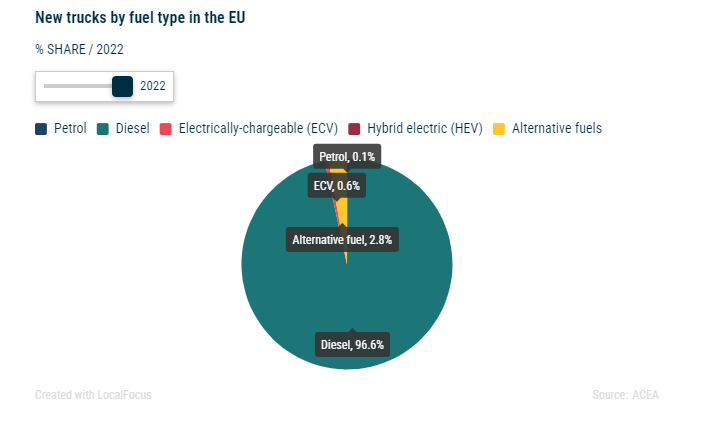
Although electric vehicles have been discussed for many years, a huge part of the industry still doubts the concept. That is evidenced, among other things, by the fact that 96.6% of all newly registered trucks in the European Union in 2022 were combustion-powered. The share of electric-powered vehicles in the European road transport market was just 0.6%.
The lack of confidence in electric vehicles, especially electric trucks, is mainly due to inadequate charging infrastructure, of which there are still too few to provide drivers with a sense of security. While driving short distances could still prove feasible, it is impossible to imagine completing a long distance with a standard load.
On the other hand, constructing widespread electric truck charging stations is a massive undertaking. This is because advanced technologies and a much larger amount of electricity are involved than in the case of passenger vehicles. New points of this type will certainly be created on the European map, but it must be taken into account that the development of the network will probably take at least several years.
In parallel with electric cars, another branch of green road transport is also developing in the form of green fuels. Hydrogen fuel cell trucks have the largest share of this market, although it must be said that everything is still in the prototype stage.
Logistics in the Service of Green Transportation
Logistics processes, particularly route optimization, also play a significant role in reducing the negative environmental impact of road transportation.
Unique, high-tech Big Data solutions are now being deployed as part of transportation logistics management. They perform several roles, including:
- Collecting and analyzing all information on product, GPS, weather, and shift schedules and determining the most economical routes.
- Providing precise insights into vehicle location and status–for instance, whether it is on route, broken, or under maintenance.
- Planning vehicles’ capacities to meet different demand situations. This includes combining several orders into one to reduce the number of courses and eliminate empty runs, which not only negatively impact the environment but also generate financial losses.
- Optimizing transportation networks by opening up multimodal transportation options and combining road with rail, sea, or air freight. Although this reduces the role of road transport, it does not exclude it 100 percent. It still proves indispensable when there is a difficult-to-access area to cover or a stretch of road from a warehouse to a port and vice versa.
One of the biggest challenges for the uptake of sustainable logistics in transportation is the high upfront cost. Closing the gap between sustainable practices and high-end logistics systems means investing time and money in research and development of solutions, which not many transport companies can afford.
Also, the traditional mindset of “never change a running system” is still prevalent throughout the industry. Many companies are not open to developing and implementing new processes and systems and retraining employees.
To address these challenges, it’s important to tackle the financial barriers and resistance to change within the industry. That involves government incentives and subsidies and forming partnerships for shared investments in sustainable logistics projects. Incremental approaches, starting with low-cost, high-impact changes, can also help gradually adopt sustainable logistic practices.
Final Thoughts
The green paths outlined above are just some of the growing number of solutions the automotive and transportation industries are deploying and scaling to achieve their sustainability targets. There is still a long way to go before these industries become fully sustainable.
Yet, by building on their progress and continuously finding ways to tackle challenges, there’s no denying these industries are on the right track–charting a more positive climate outcome for everyone.